
Making it easier to do business is a key element of our strategy, says Foreign Secretary S Jaishankar.
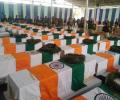
Pulwama must become the defining moment in our fight against terror, effecting a sea change in our mindset. The erratic, blow hot blow cold approach, the hallmark of our anti-terror-Pak-Kashmir policy must end. In its place is required a pragmatic, comprehensive, robust hard line course that is relentlessly pursued even in times of relative calm until the final objective is met, namely the eradication of separatism and the total annihilation of terror, says Vivek Gumaste.


Being a pragmatist Modi is not likely to give preference to China over Japan. Both security and economic aspects are likely to shape Modi's decision in terms of engaging the two biggest economies of Asia, says Sana Hashmi.

Prime Minister Narendra Modi will be reciprocating the reception he received from the Israeli PM during his visit last July, report Archis Mohan & PTI.

'Xi Jinping is keen that the second Trump-Kim summit happens soonest.' 'Kim is reported to have told Xi that he expects to achieve a result from a second summit that the international community would welcome,' points out Dr Rajaram Panda.

'During his visit to Vietnam on September 3 -- the first visit by an Indian prime minister in 15 years -- Modi will notice the widespread anti-China sentiment in that country.'
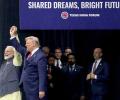
'The biggest takeaway is that the US-India relationship, which has sputtered a bit in recent months, enjoyed a big boost.'

The government is set to clear a proposal to raise a dozen battalions and induct close to 12,000 fresh personnel in the Indo-China border guarding force ITBP to bolster the force's presence along this strategic frontier.

India on Thursday bluntly told the US that surveillance of political leaders and others in India by the American intelligence was "unacceptable" to which the US responded by saying that any differences that may exist can be resolved by intelligence communities of the two countries.
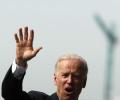
United States Vice President Joe Biden on Monday left for a rare vice presidential trip to India for the first leg of his visit to the Asia-Pacific region.
'We had to convince our people that we were doing nothing that would erode our strategic programme. We were all the time arguing that we are not doing anything, which will remotely impact on our strategic programme.'
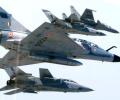
'We could quibble with each other whether there were 25 terrorists killed or 250 killed.' 'The message is more that India undertook such an aerial attack and this attack has actually changed the paradigm.' 'The change in paradigm is that India has shown by the surgical strike in 2016 and the aerial strike of 2019 that we will not just sit back and tolerate terrorism which killed so many of our people.' 'We will hit back and by hitting back we will raise the costs of such activities.'

'The Modi government knows that much cannot be expected of Pakistan till the Kulbhushan Jadhav issue is resolved,' says Rajeev Sharma.

"We are committed to building a new India. We have to do this as early as possible," he said.
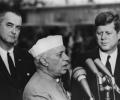
As Prime Minister Narendra Modi begins his historic visit of the United States of America, here's a look at some landmark visits by Indian prime ministers to the United States of America.
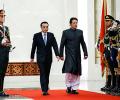
'Imran cannot escape responsibility for providing a mask to the Pakistan army to engage in unlawful activities and to wage aggression after India retaliated to the terrorist attack,' says Ambassador T P Sreenivasan.
'We need to be in a perpetual state of aggression, and able to swiftly change the goal posts to keep Pakistan in a state of imbalance,' argues Sanjeev Nayyar.
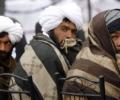
We should be prepared for a phase of increased tensions in India-Pakistan relationship thanks to the evolving situation in Afghanistan, says Shyam Saran.

'Devyani -- she is a public servant and her personal life has already received far too much attention -- and her ambitious father now need to retreat to the background so that wiser diplomatic heads restore sanity to India-US relations as India prepares for parliamentary elections,' says Ambassador K C Singh.

RM took stock of progress in production of the fighter jets whose delivery to India will begin in September next year.

Himesh Reshammiya, the only valid reason for Teraa Surroor's existence, does not show any expression. Not even one. Not even a quarter, notes Sukanya Verma.

'The surge of Saudi nationalism is the last thing Washington wants,' says Ambassador M K Bhadrakumar.

'We want to provide data, we want to provide consultation, but we don't want to lecture.' 'The consciousness about this issue in India is starting to get quite high and if we can help contribute to solving this air quality issue in a spirit of partnership with the Indians, it would be a big achievement.'
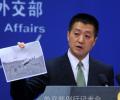
Chinese Foreign Ministry spokesman Lu Kang displayed a photograph of Indian 'incursion' into Donglong area.
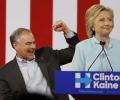
Rediff.com reproduces this 2014 interview with Tim Kaine where in he discusses the new opportunities to foster Indo-US trade and the improvement in ties.

Prime Minister Narendra Modi has made a stunning entry into the top 10 list of Twitter users with a vast following, rocketing to the #2 spot.
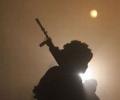
Why does the army remain embroiled in counter-insurgency, denying itself a peace dividend even after expending blood and treasure in imposing calm?
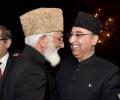
'The Modi government has turned the basic fundamentals of its Pakistan policy on its head.' 'It means an admission that its hands-off-Hurriyat policy was flawed and it is ready to engage with Pakistan without minding if the Kashmiri separatists talked to the Pakistani government,' says Rajeev Sharma.
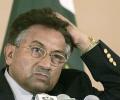
Pakistan's ruler Pervez Musharraf and his top diplomats made a U-turn on talks with India after the then Prime Minister Atal Bihari Vajpayee released Hurriyat leaders in early 2000 as part of his peace initiatives on Kashmir, according to a declassified US cable.
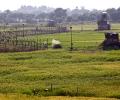
'The incidents have remained confined to the paramilitary forces on both sides with both the armies scrupulously avoiding getting involved. While this incident has been going on, the LOC has been reasonably quiet. Cross border firing achieves no tactical or strategic aims and is more a symptom of hostility. Unfortunately, India has to learn to live with this. Like Israel, we must construct shelters for the border populations and be ready to retaliate in kind,' says Colonel Anil A Athale (retd).

In spite of irritants and hiccups in the relationship, a few deliverables are expected of the prime minister's visit to China, says Rup Narayan Das.

Following is the full text of Prime Minister Manmohan Singh's speech at the Central Party School in Beijing on Thursday:

'Diplomatic engagement will continue even as India keeps all its options open with respect to discretely targeting the Pakistani military and its terrorist proxies.'

Amid escalation in violence in a number of Gulf countries, India on Thursday expressed deep concern over the rise of fanaticism, extremism and terrorism in parts of the Arab region, saying they are tearing apart the fabric of societies as well as affecting regional stability.
The two countries that will be most affected by the internal developments in Pakistan are India and the United States, says Bob Blackwill. Aziz Haniffa reports

'Assuming the official defence allocations represent the true picture, the $142 billion figure still represents a phenomenal increase and surpasses that of Japan ($42 billion), India ($40 billion), South Korea ($33 billion) and several other Asian countries put together and shows that China is flexing its military muscle.'
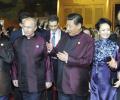
The American, Russian and Chinese reactions to the Uri attack indicates how tough it will be for India to 'isolate' Pakistan internationally,' says Ambassador M K Bhadrakumar.
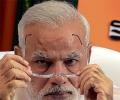
One of the biggest ways in which recent government actions have been seen as investor-unfriendly is New Delhi's decision to unilaterally revisit almost every Bilateral Investment Treaty it has signed with other countries, says Mihir S Sharma.
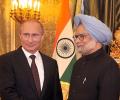
The 13-page joint statement issued after Prime Minister Manmohan Singh's annual summit with Russian President Vladimir Putin shows the breadth and depth of relations between the two countries and the trust factor that has been constant element behind it.
